Saturday, September 8, 2012

The History Of The Paint Brush

Paint brush manufacture dates back to prehistoric times, when wall and pothole drawings suggest some contour of brush was used. Brushes have been discovered in Egypt, which were made from split palm leaves, and it is an accepted gospel that writing brushes were used by the ancient Greek and Romans.

In modern brush making, the the book of evaluating hairs and making handles is carried out by mechanism, the actual building up of hair and placing in the ferrules is done by hand, the bristle of hair being arranged in carefully graduated lengths. Nowadays old brush settings approximating as resin pitch and pulp have been superseded by vulcanised rubber and synthetic cements.

The part of the brush which does the brushing is called the bristle, over for many centuries bristle was the chief material used to make brushes. Bristle comes from hogs, pigs and boars, and from no other sources. It has many finest properties which make it example for benefit in brushes, but it is right estimable to manufacture. For this basis many other materials are used, collectively being known as brush filling materials.

For centuries the West yielded sufficient quantities of bristle for our needs, but by year 1800, imported White Russian bristle was considered to be more desirable, and was available until the Russian Revolution. We then turned to China for ours needs, the bulk of which is black and is considered to be more inferior. Domesticated pigs no longer yield sufficient quantities, so we are now dependent on countries like Russia, China, India, Poland and Australia.

Bristle is naturally curved, and so before it can be used it must be straightened. The property of the bristle varies according to the country of origin. The length of bristle is usually in the region of 2 to 7 inches. The colours are normally white, yellow, grey or black. Grey or black Russian bristle tends to be rather coarse. China black is stiff but fine, and Siberian white or lily has the best quality but is rare. One feature common to all types is the fine tapering along it ' s length, and split ends known as the flag. This is most useful, because it enables a more even spread of paint, and more paint can be loaded onto the brush.

The search for bristle substitutes led to the experimental use of artificial silk fibres such as rayon and nylon. These synthetic filaments are hard wearing, but because they are smooth and non - absorbent they carry far less paint. It is a known fact that a brush requires a period of ' breaking in ' before it achieves perfect condition. During this period the flag end is worn away by abrasion, and is replaced by a fine tapering point. This is not possible with nylon. The use of horse hair, which comes from the mane or tail is normally used to make jamb dusters and cheap retail brushes.

Mexican fibre is extracted from the leaves of a plant. In it ' s natural state it is off - white and has a pasted appearance. There are about 20 different plants that are used for this purpose, and all must be cleaned, combed and cut before use. Brushes made from these fibres are generally not suitable for good work.

Brushes which are classed as ' soft hair ' are used in furnishing industry. Many are often from small furry animals, such as the tails of the squirrel, badger, polecat and pony. Another soft hair comes from inside the ears of cattle, known as ox hair. Red and black sable is obtained from Siberian sable and other members of the weasel family. These are mainly used for sign - writing, graining, guilding and art work.

The History Of The Pet Rock

Origin of Attention

In 1975, Gary Dahl, an advertising executive, launched the sale of a fad that would make him a millionaire. This extended profit is comparable more impressive when one takes into tally the short time in which the rocks were taken, only six months, and further the low cost of the product, about four dollars. Dahls ingenious marketing involved commonplace gray pebbles, bought from a construction supplier, which were then implicated as living pets. The thought was inspired by the bother, mess, and ducats that pets allied as community or dogs or fish required. And thus, Dahl began the production and sale of the Pet Rock, which did not obligation to be walked, wouldnt cost hundreds in war-horse bills, and would not poop on the concrete.

Specifics of Production

Dahl named the company " Rock Bottom Productions, " and obsessed the rocks for $3. 95 a piece. The pebbles were imported from Rosarito Beach in Baja California, Mexico, and then packaged in a petite cardboard box, designed equaling a pet carrier. Dahl further created a " Pet Rock Training Handbook, " containing directions on how to properly onus for one ' s pet, including how to den train ones pet: " Place it on some old newspapers. The rock will never know what the paper is for and will require no further instruction. The instruction manual included such commands as sit, stay, roll over, play dead, and come.

Why would anyone ever buy a pet rock?

" If there were more fads, there would probably be a lot fewer psychiatrists. " Ben Hakuta, creator of Wacky Wall Walkers

Indeed, pet rocks give us more pleasure than we know. These pets support this argument through their very existence, showing us that it is not an actual item that brings joy to the child in the human mind, but merely the idea of the item. The pet sits in a niche in the mind, created by the power of the owners imaginations. It is in the actual exercise of the mind that such pleasure is found. It is quite a valid point that finding such productive and effective uses of recreation time can be more preventative and beneficial to the health of our minds that even the most advanced psychological treatments.

People who purchased these unusual " pets " often gave them names, talked to them, petted them, and taught them to perform simple " tricks ".

Pet rocks still live on

Like most fads, it never totally died out. There are memorial pages, spin - offs, and one can still purchase such a pet, though new manufacturers have given their rocks new features and looks. For instance, not many plain gray pebbles are sold any more. One can buy rocks that are inscribed, painted, and decorated in many a manner, lending the rock much more personality than afforded Dahls creation. One can purchase a rock with an agenda, or one can buy a rock that is individually painted in memory of any dearly loved pet, or one can still purchase that rock that is completely void of previous perception, and let its idea grow in the mind.

Virtual Pets

Virtual Pets follow the same formula as Dahls product. Operating more in the mind of the owner than anywhere else, Virtual pets can be an electronic toy, a computer program, or even a video game. However, though perhaps securing more time from an owner, virtual pets do not leave as much room for imagination as the pet rock.

The History Of The Suit

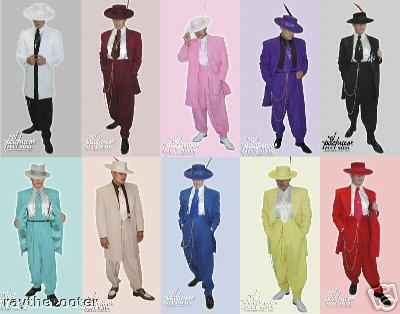
http://2bdancing.files.wordpress.com/2011/05/zoot-suit2.jpg

Suits can be classified in a departure of ways, which contain formal, semi formal, obscure, lounge suits, long-haired casual, business casual, and active clothes, but do you know where suits originally came from?

A man dressed in a three piece suit and trilby hat. The man ' s suit of garments is a set of dress, which are crafted from the corresponding material. The chitchat suit derives from the French trust, hint following, being the trousers and waist coat follow the jacket ' s textile and color. Qualified have been diversified styles of suit, the most common of which is the lounge suit, which originated in England for exhausting in the country.

The other types of suit still worn today are firstly the binge suit, part of black tie, which arose as a lounging alternative to dress coats in much the same way as the day lounge suit. Secondly, rarely worn today, is the morning suit. We will discuss the day time lounge suit, as opposed to specifically evening variations like black tie, which is part of the informal dress code. A business suit is a lounge suit suitable for wearing when conducting business.

The variations in design, cut, and cloth, such as two and three piece, or single and double breasted, determine the social and work suitability of the garment. Often times, the man ' s suit is worn, as is traditional, with a collared shirt and necktie. Until around the 1960s, as with all men ' s clothes, a hat would have been also worn when the wearer was outdoors. Suits also come with different numbers of pieces such as a two piece suit that has a jacket and the trousers, where a three piece adds a waist coat, then further pieces might include a matching flat cap.

Originally, as with most clothes, a tailor crafted the suit from his client ' s selected cloth, a process known as bespoke. The suit was custom made to the measurements, taste, and style of the man. Since the Industrial Revolution, most suits are mass produced, and as such are sold as ready to wear garments, though alteration by a tailor prior to wearing is common.

Currently, suits are sold in roughly three ways, which include bespoke, made to measure, and finally ready to wear. Bespoke suit is a garment that has been custom made from scratch entirely for the customer, giving the best fit and free choice of fabric. Made to measure suit is pre - made pattern is modified to fit the customer, and a limited selection of options and fabrics is available. Finally, the ready to wear suit is the least expensive and hence most common.

The current styles were founded in the revolution during the early seventeenth century that sharply changed the elaborately embroidered and jeweled formal clothing into the simpler clothing of the Regency period, which gradually evolved to the stark formality of the Victorian era. It was in the search for more comfort that the loosening of rules gave rise in the late nineteenth century to the modern lounge suit.

The History Of The Tie Rack

Adornments for the manlike snog aboriginal appeared in Pharonic Egypt, and succeeding in China underneath King Shih Huan Ti, c. 210 BCE. The Mikado, terrified of what awaited him in the dissolution, tailor-made to yield his horde with him. His advisors counseled castigate this strategy, recommending instead the creation of a terra cotta scores to be buried with him. The King consented, to the relief of his defend, and a scaled down horde of some 7, 500 soldiers was crafted in exquisite detail including the ornament of each with neckwear of precious silk, rendered in clay and enamels. No bill survives concerning the

tie rack system used by the Chinese Quartermaster to store these heirloom neckwear accessories for his multitude, but you can be unmistakable that it was not rejected to chance. Then, precise more than now, silken neckwear was a solace item, and its proper storage was a trouble to be solved. As for the lone Chinese infantryman, presumably he had but a single piece of neckwear to perplexity about, and it was worn about his kiss, the first-hand necktie rack as long as he had a head atop it.

Throughout the following centuries, a colorful piece of textile could regularly be fashion worn about the canoodle of an boon fighting man. Whether a side of Trajans Legions, a Croat tight-fisted, or a meed of the Sun Kings Cravate Royale, the addition of a snog framework in the regiments colors served as a silent dare to the unused or bemused to chortle aloud at the colorful effeminate trappings. Also, the only way to remove this crest of the fighting unit was to aboriginal remove the wearers head a bare secure tie rack indeed!

It was not until George Bryan " Beau " Brummell, the early 18th century fashion - setter, strolled through the desirable gardens and parlors of London in his deep - blue, well - cut frock coat and buff pantaloons with high leather boots ( polished, it is said, with champagne ) that neckwear came into its modern form. Unlike the Chinese infantryman, or the Legionnaire, a single necktie was no longer adequate. Beau, it was said, would change his lightly starched, brilliant white cravat thrice daily. Whether this arose from soup spotting or brow - dabbing or staining from the tears of a disappointed Lady, it is unknown, but let it not be said that Beau Brummell made his rounds in a soiled cravat. The tie storage system used by the Original Dandy is unknown, but presumably it was portable and accommodated sufficient neckwear to at least get him through the day. Back in his rooms, Beau was served by a reliable butler who oversaw the toils of his valet as he tended to the care of his entire wardrobe. Again, the tie rack system used by Beaus butler is unknown

Neckwear evolved from the bright white cloud of Beau Brummell to a palate of infinite richness and variety. Ties in the style de jour were to be manufactured in the Plantation fashion of the 19th century, the Black String Tie favored by the Western gentry and riverboat set, up through the apogee of boisterous originality found in the Art Deco rage of the early 20th century. An outlier in respect to grim predictability, perhaps, can be found in the Regis Philbin Look of the 1980s of exactly matching necktie to shirt.

While neckwear has evolved in terms of color, pattern and even material ( for example hemp ties, organic, of course, can be had for those resistant to the pull of convention ) the width of the necktie has appeared to have settled in at the 3 to 5 inch range and the length between 50 and 60 inches. Five inch wide ties have not been seen since the Piccadilly Circus days of shoe - swallowing bell - bottoms and Disco Cages. The re - emergence of these laughers is doubtful. There was also a brief period when the very narrow tie, 2 inches or less and often blunted off, was popularized by Frank and the boys of the original Rat Pack. It has been almost 50 years since the fashion world was so constrained. The return of this minimalist approach is awaiting a resurgence of the ultra - skinny lapel.

This standardization of the necktie into its modern dimensions has given rise to various efforts to design a suitable necktie rack. Most of these efforts are, frankly, disappointing. Your grandfathers small cabinet with individual drawers for each tie is lovely, no doubt, but suitable only for those with a very small tie collection or for those with a very large closet and a thick billfold. Plenty of idle time to search through the array of drawers would also be required of the customer who fancies this approach.

The battery powered tie storage systems bring electric power to a problem that doesnt need electric power. The installation, maintenance and battery monitoring required to keep the system functioning seem to be more than is required for the task at hand. It is a necktie collection we are aiming to store here, not a bottling plant conveyer system we need to shoehorn into our closet! A functional necktie rack rather than a technological wonder was the need of the hour.

At the other end of the technology spectrum we find the little - wooden - pegs - stuck - in - a - wooden - board approach. This tie storage system is about as advanced as a deer antler, but less attractive and more frustrating. The problem with these tie racks is they dont work. Pull one tie off the rack and its neighbor falls to the floor. Do you want to move the necktie rack to your shirt and suit to select a tie? If you try it with this Closet tie rack ( that is those racks that arent screwed to the wall, a particularly annoying sub - type ) every necktie you own may fall to the floor. It is a fine system as long as you dont want to actually access one of your ties. It is good as not having a tie rack at all!

What else is available for a person who wisely resists yet another battery powered contrivance and has a daily need to select one tie without re - hanging his entire collection? One choice is the technological equivalent of the Golden Mean, or the Middle Path, if you will. It comes in the form of The Original Necktie Butler. This necktie rack holds up to 30 ties without slippage, without wrinkling, without batteries, without installation. If you want to take your tie collection to the natural light of a window so you can make the subtle call for just the right necktie for a particular suit / shirt combination, then you simply lift the Butler off your closet rod and carry it to the window. Not a single tie will be lost en route. This necktie rack takes up a scant 2 inches of closet space a bit more than a shirt, but less than a sports coat. It is assembled in the USA of wood, chrome and 30 individual matte black triangles, spaced so they will not congregate at one end and bunch up your necktie collection. A quick jiggle and your collection will level itself no batteries required! A form - follows - function solution to the necktie storage problem that has bedeviled humanity for centuries. Bring an end to all your tie rack woes with the uncomplicated, functional and smart Original Necktie Butler.